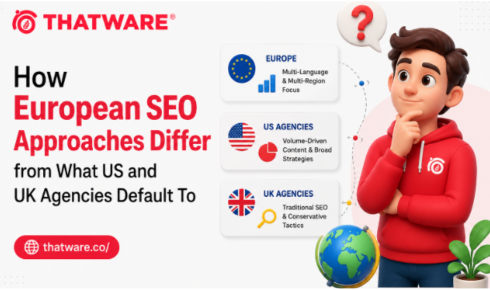
There’s a tendency among US and UK agencies to treat European markets as straightforward extensions of what they already do — translate the content, maybe tweak some keywords, point the hreflang tags in the right direction, and proceed. The results of this approach tend to disappoint, and the reason is usually the same: European markets aren’t just the American or British market in a different language. They have distinct search behaviors, distinct competitive landscapes, distinct regulatory frameworks, and distinct cultural norms that shape how content needs to be written and how authority needs to be built. The european seo company that actually understands this has built capabilities that most US and UK agencies default away from. And the difference between seo services europe done with genuine market understanding versus done with American assumptions shows up clearly in results within 12 to 18 months.
Here’s where the approaches actually diverge.
Search Behavior Differences That Actually Matter
Search behavior differences across European markets are more pronounced than most US agency strategists expect. They show up in query length and structure, in the relative weight of product research versus purchase intent queries, and in the content formats that earn engagement.
German-speaking markets tend toward longer, more specific queries. German consumers research extensively before purchasing and respond to content that’s detailed, precise, and backed by evidence. The content style that performs in the German market is more technical and thorough than what typically performs in US or UK markets for the same product category.
French and Italian markets show different patterns — more brand-sensitivity in some categories, different seasonal purchase cycles, and strong preferences for locally-oriented content over content that feels internationally generic. The content that ranks for a competitive query in France often has a more editorial, less conversion-focused tone than its US equivalent.
Nordic markets have very high digital literacy, which means users detect and reject content that feels produced for search rather than produced for readers. The thin, keyword-optimized content that might perform adequately in some US niches tends to perform significantly worse in Scandinavian markets where users are more likely to bounce quickly from low-quality pages.
Defaulting to the content approach that works in US or UK markets and expecting it to transfer is how European SEO programs underperform.
The Regulatory Dimension
European search marketing operates within regulatory environments that US and UK agencies frequently underestimate.
GDPR has direct SEO implications. The tracking data available for content performance analysis, audience understanding, and attribution modeling is more limited in EU markets than in the US. seo services europe strategies that depend on behavioral data for content optimization need to be adapted to work with more constrained data environments.
Specific verticals face additional regulatory constraints. Financial services content in Germany, France, and other EU markets operates under frameworks that restrict certain types of claims and require specific disclosures. Healthcare content faces E-E-A-T requirements that are consistent with other markets but combined with EU-specific regulatory frameworks for health claims. Legal services content must navigate bar association rules that vary by country.
US agencies unfamiliar with these frameworks often produce content that’s effective from a pure SEO perspective but creates compliance risk for their European clients. The risk usually only becomes apparent after the content has been published and circulated.
Link Building: The European Landscape
The link building landscape in Europe is fragmented in ways that require market-specific approaches. There’s no unified “European media” the way there’s a coherent US digital media ecosystem. Each major market has its own set of authoritative publications, its own influencer landscape, its own patterns of editorial coverage.
Building links for a German client requires relationships with German business and trade publications. Building links for a French client requires a different set of relationships entirely. The US agency that has strong US media relationships and decent UK relationships starts essentially from scratch in each European market, and building genuine editorial relationships takes time.
The alternative — using the same international English-language publications for link building across all European markets — produces link profiles that look internationally generic rather than locally authoritative. For brands competing against local competitors with genuinely local link profiles, this is a disadvantage.
The Multilingual Technical Foundation
The technical infrastructure for multilingual European SEO is more complex than single-language SEO in ways that have compounding effects when done wrong.
Hreflang implementation across many languages and regions requires careful management to avoid the canonical confusion and ranking dilution that incorrect implementation causes. URL structure decisions — ccTLD versus subdirectory versus subdomain — have strategic implications for how authority accumulates and how country-specific targeting is signaled to search engines.
Content management systems that weren’t designed with multilingual SEO in mind often create technical debt that’s painful to resolve at scale. Duplicate content across language versions, incorrect canonical configurations, and language detection scripts that create indexation problems are all common in European sites that were built by teams without multilingual SEO expertise.
The agencies doing European SEO well have typically built specific expertise around multilingual technical architecture — not as an add-on to their standard technical practice, but as a distinct capability they’ve developed through repeated engagement with the specific problems European multilingual sites face.
The markets are worth the complexity. Europe represents significant search opportunity in virtually every category, and the brands that approach it with genuine market understanding rather than translated US assumptions consistently outperform those that don’t.